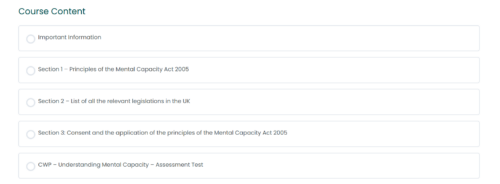
- Understand the principles of mental capacity as they apply to your role as a PA
- List of all the relevant legislations in the UK
- Understand the application of the principles of mental capacity and consent in your role
-
 Aim: To develop a clear understanding of mental capacity and how it can affect how you deliver support to the individual as a personal assistant (PA) Objectives: By successfully completing this course you will be able to:
 -

 Aim: To ensure that all members of staff are supported in the workplace. Objectives: By successfully completing this course you will be able to:
- Identify a minimum of 5 basic workplace causes of mental health issues
- Explain how to implement at least 5 strategies to tackle basic causes of basic mental health issues
- Describe the benefits of promoting openness about mental health
- Identify the 6 core standards of mental health first aid
- Explain how to create a workplace mental health plan
- List at least 6 strategies that you can implement to promote the wellbeing of all members of staff
- Identify at least 3 benefits of encouraging conversations about mental health
- Explain why it is important to provide employees with basic mental health support
- Identify at least 10 factors of the work environment of your team members that promote mental health
- Explain how to implement proactive opportunities for your team members to discuss their health and wellbeing, and the impact their work environment has on it, with their team leader(s)
- List at least 6 techniques for training individuals to be able to treat their colleagues in a way that does not negatively impact their mental health
- List at least 3 benefits of regularly monitoring the mental health of your team members
- List at least 3 methods of monitoring the mental health of your team members
- Explain what an annual wellbeing report is, and to know how to create one
-
 Aim: To develop a clear understanding of working in a person-centred way Objectives: By successfully completing this course you will be able to:
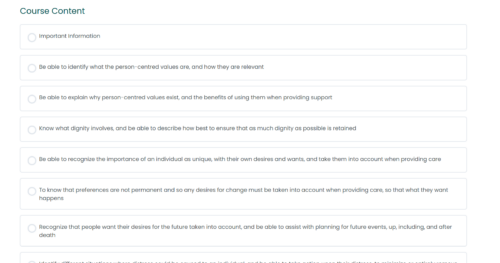
- Define what is meant by person-centred values
- Understand how to work in a person-centred way
- List the relevant legislations in the UK
- Explain the importance of mental capacity when providing person-centred care
- Understand how to support the individual by addressing factors that may be causing pain, discomfort or emotional distress
- Understand how to support the individual to maintain their identity, self-esteem, spiritual and overall wellbeing
-

 Aim: To make you aware of mental health conditions, dementia, and learning disabilities, and the experiences people have with them. Objectives: By successfully completing this course you will be able to:
- Describe how a mental condition can change the needs of an individual
- Explain the importance of promoting positive mental health and wellbeing
- List 3 adjustments that you may need to make to personalise care delivery
- Recognise 3 early warning signs of mental health conditions, dementia, or learning disabilities
- Describe the relevant legislation
- Describe what mental capacity is and how it relates to the topic
-

 Aim: To understand the definition of mental capacity and how it plays a vital part within a Health and Social care setting. Objectives: By successfully completing this course you will be able to:
- Explain the definition of ‘mental capacity’
- Identify at least 5 different causes of lack of mental capacity and the effects on a day-to-day basis
- Identify and list all five statutory principles
- Explain the process of assessing a person who lacks mental capacity
- Explain the decision process and why working in an individual’s best interest is vital
- Describe the powers and bodies that support the mental capacity act
- Describe the importance of code of practice
- Explain the intentions of the Deprivation of Liberty Safeguards and be familiar with restraints and restrictive practices