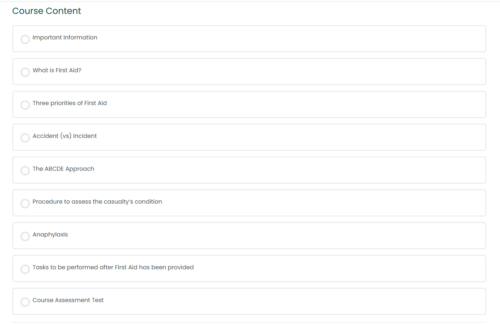
- Describe what is meant by First Aid
- Explain about the 3 priorities of First Aid
- Describe the difference between an accident and an incident
- Describe the procedure to assess the casualty’s condition
- Explain how to follow the Resuscitation Council’s guidelines, including the ABCDE approach
- Explain how to help an unconscious but breathing person
- Explain how to help an unconscious and not breathing person, including cardiopulmonary resuscitation (CPR)
- Identify what a defibrillator is, and how to use an automated external defibrillator (AED)
- Explain how to provide first aid for wounds, bleeding, burns, scalds, choking, seizures, shock, and issues with blood circulation
- Identify the signs of 3 heart conditions
- Identify the signs of a stroke
- Describe the symptoms, triggers, and action plan to help anyone affected by anaphylaxis
- Identify the essential tasks to be performed after providing any form of first aid
-
 Aim: To understand how to preserve life, prevent the situation worsening and promote recovery. Objectives: By successfully completing this course you will be able to:
 -
 Aim: To perform basic first aid in an emergency situation at work. Objectives: By successfully completing this blended course you will be able to:
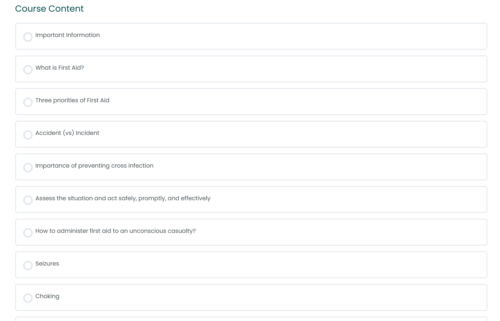
- Explain the definition of First Aid
- Identify the 3 priorities of First Aid
- Describe the importance of preventing cross infection
- Explain and demonstrate how to assess the situation and circumstances in order to act safely, promptly, and effectively in an emergency
- Explain and demonstrate how to administer first aid to a casualty who is unconscious but breathing
- Explain and demonstrate how to administer first aid to a casualty who is unconscious and not breathing
- Explain and demonstrate how to perform cardiopulmonary resuscitation (CPR)
- Explain the use of an automated external defibrillator (AED)
- Explain what seizures are and demonstrate how to provide first aid to an individual who is suffering from them
- Explain and demonstrate how to help an individual who is choking
- Explain and demonstrate how to provide first aid for wounds, bleeding, burns, scalds, shock, and issues with blood circulation
- Describe the need for record keeping
-
 Aim: To know how to provide basic life support, to save lives in the event of an emergency. Objectives: By successfully completing this course you will be able to:
- Identify the correct procedure to carry out basic life support
- Recall how to carry out a primary survey (initial assessment)
- Recall how to put someone in the recovery position
- Recognise the importance of airway maintenance, and how to deal with obstructed airways
- Recall how to perform cardiopulmonary resuscitation (CPR) for an adult
- Recall how to perform cardiopulmonary resuscitation (CPR) for a child
- Recall how to perform cardiopulmonary resuscitation (CPR) for an Infant
- Recall how to assist an adult that is choking
- Recall how to assist a child that is choking
- Recall how to assist an infant that is choking
- Recognise the importance of record keeping with regards to basic life support
- Identify a minimum of one piece of legislation surrounding basic life support