Welcome to the Halo Staffing Care Workforce Pathway eLearning course on person-led support.
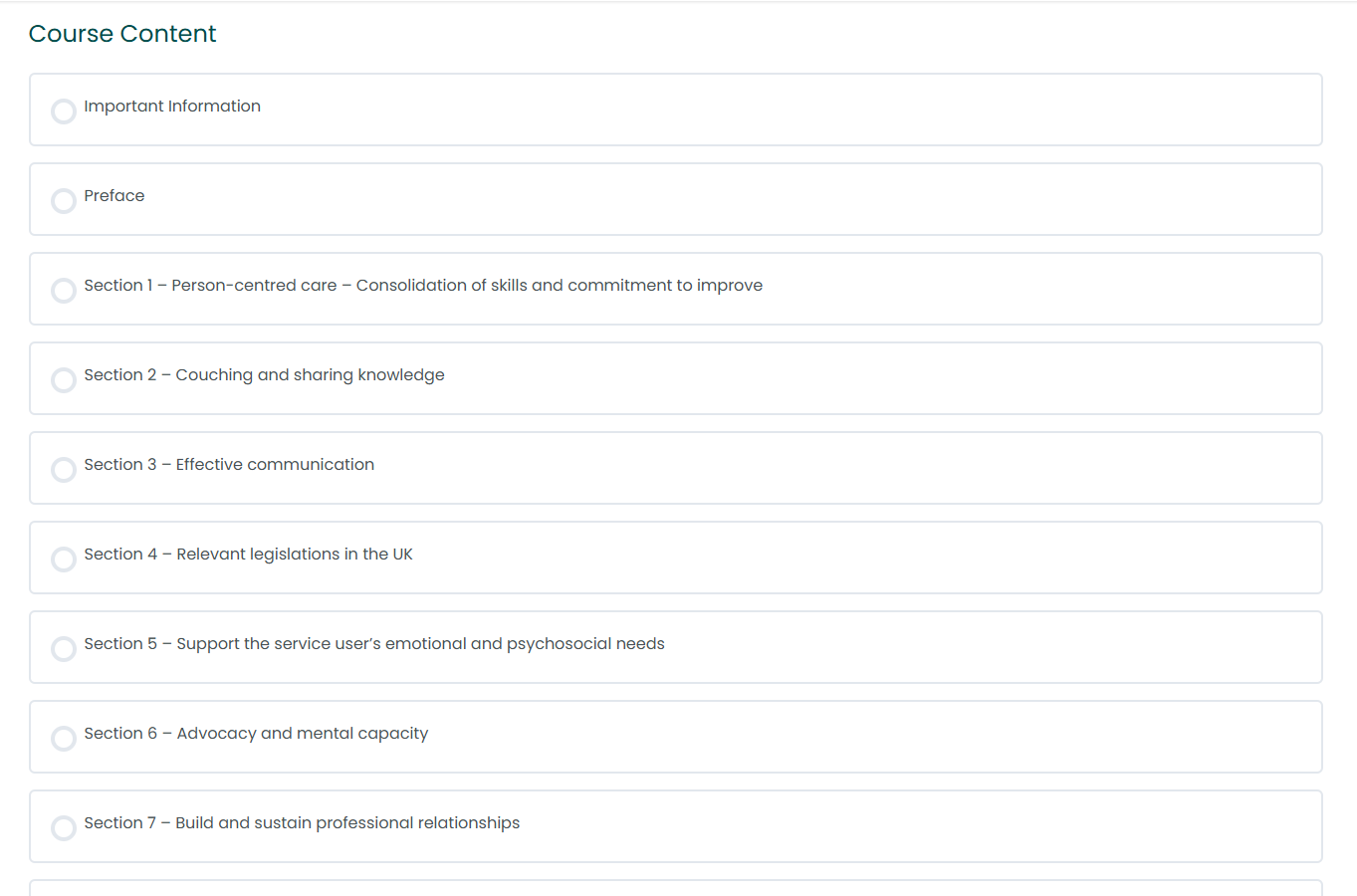
We will begin this course with some information about demonstration of commitment to develop and consolidate expertise or skills necessary to provide person-led support.
The next section will be about proactive coaching, sharing knowledge and best practice with your colleagues.
This will be promptly followed by a section which will inform you about the importance of showing strong written and verbal communication skills, including the ability to communicate complex information in a clear and accessible way.
At this point we will list all the relevant legislations in the UK.
The following section will be about supporting the emotional and psychosocial needs of the service user and being a role model for effective practice.
After that, we will inform you how to use knowledge and understanding of the people you support to advocate for their wishes when they are unable to do so.
We will then inform you how to build and sustain professional relationships, including establishing accountability and negotiating responsibilities.
The next section will be about working autonomously within your scope of practice.
The following section will inform you about your own role, responsibilities and scope (including limitations) of practice.
We will also inform you when to ask for additional support, who and how to escalate.
Here we will discuss about the importance of having the confidence to speak up when things do not feel right.
At this point, we will inform you about some strategies to develop resilience in yourself and know how to seek support to deal with uncertain situations.
The next section will be about recognising and reporting any factors that may adversely impact safe and effective care provision
We will then educate you about health inequalities, and your own role in working towards reducing them.
Finally, we will inform you how to maintain an accurate and up-to-date record, ensuring all care interventions and observations are recorded in a timely manner.
You can view the introduction video of this course below.
Is this for me?
This course has been carefully designed for organisations who want to learn about the Care Workforce Pathway – Understanding and delivering person-led support. As specialists in providing staffing solutions Halo Staffing’s courses are relevant for many industries including health and social care for carers, support workers, nurses and managers. Completing this course will ensure that you are fully up to date with relevant content to provide you with the skills and knowledge necessary to excel in your field. On successful completion of this course, you will be issued with a certificate and digital badge valid for 1 year.
Why should I take this course?
You should take this course if it’s necessary for you or your team develop and clear understanding of ensuring equality, diversity and inclusion are a part of your practice. Keeping in line with the Care Workforce Pathway guidelines, The Health and Social Care Act 2008 (Regulated Activities) Regulations 2014: Regulation 9, The Mental Capacity Act 2005 and The Care Act 2014.
What are the benefits of taking this course?
This course helps staff deliver support that is led by the individual rather than the service. By learning how to empower people and respect their choices, staff can improve engagement and outcomes. It also supports more flexible and responsive care. Overall, the course promotes independence and person centred practice.
What will I learn?
This course will provide you and/or your team with a clear understanding of the role of an enhanced care worker, coaching and sharing knowledge, effective communication, relevant legislations in the UK, how to support the service user’s emotional and psychosocial needs, advocacy and mental capacity, how to build and sustain professional relationships, how to work autonomously within your scope of practice, how to seek out additional support, the importance of being confident and speaking up when you observe malpractice, health inequalities and the CQC framework to address them. Finally, you and/or your team will also learn about the importance of maintaining accurate and up-to-date records in the care setting.