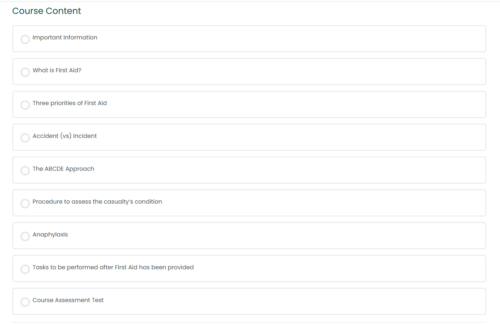
- Describe what is meant by First Aid
- Explain about the 3 priorities of First Aid
- Describe the difference between an accident and an incident
- Describe the procedure to assess the casualty’s condition
- Explain how to follow the Resuscitation Council’s guidelines, including the ABCDE approach
- Explain how to help an unconscious but breathing person
- Explain how to help an unconscious and not breathing person, including cardiopulmonary resuscitation (CPR)
- Identify what a defibrillator is, and how to use an automated external defibrillator (AED)
- Explain how to provide first aid for wounds, bleeding, burns, scalds, choking, seizures, shock, and issues with blood circulation
- Identify the signs of 3 heart conditions
- Identify the signs of a stroke
- Describe the symptoms, triggers, and action plan to help anyone affected by anaphylaxis
- Identify the essential tasks to be performed after providing any form of first aid
Supporting staff working outside of direct care delivery
-
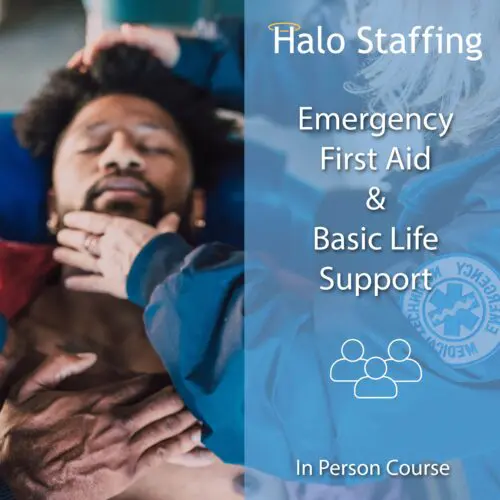 Aim: To understand how to preserve life, prevent the situation worsening and promote recovery. Objectives: By successfully completing this course you will be able to:
 -
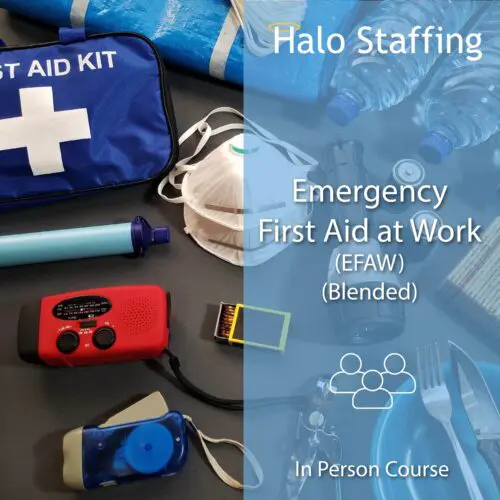 Aim: To perform basic first aid in an emergency situation at work. Objectives: By successfully completing this blended course you will be able to:
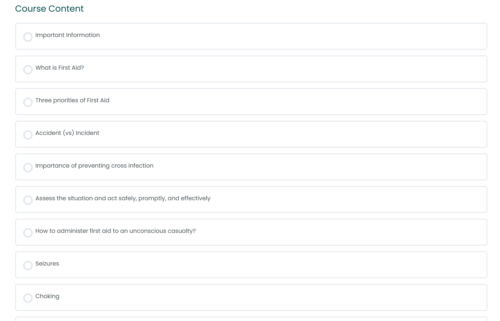
- Explain the definition of First Aid
- Identify the 3 priorities of First Aid
- Describe the importance of preventing cross infection
- Explain and demonstrate how to assess the situation and circumstances in order to act safely, promptly, and effectively in an emergency
- Explain and demonstrate how to administer first aid to a casualty who is unconscious but breathing
- Explain and demonstrate how to administer first aid to a casualty who is unconscious and not breathing
- Explain and demonstrate how to perform cardiopulmonary resuscitation (CPR)
- Explain the use of an automated external defibrillator (AED)
- Explain what seizures are and demonstrate how to provide first aid to an individual who is suffering from them
- Explain and demonstrate how to help an individual who is choking
- Explain and demonstrate how to provide first aid for wounds, bleeding, burns, scalds, shock, and issues with blood circulation
- Describe the need for record keeping
-
 Aim: To reduce the effects of injury or illness suffered at work, whether caused by the work itself or not. Objectives: By successfully completing this blended course you will be able to:
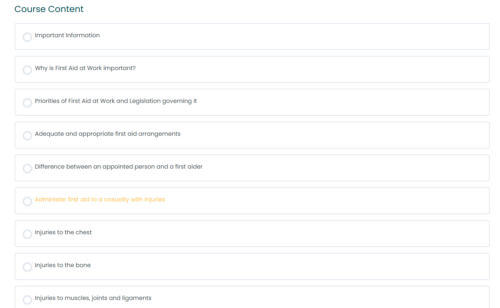
- Explain the importance of first aid at work
- Describe the legislation governing first aid at work
- Explain the 2 priorities of first aid at work
- Explain what is meant by adequate and appropriate first aid arrangements
- Describe the difference between an appointed person and a first aider
- Explain and demonstrate how to administer first aid to a casualty with injuries to bones, muscles, ligaments, joints and injuries to the spine
- Explain and demonstrate how to administer first aid to a casualty with chest injuries
- Explain and demonstrate how to provide first aid for burns and scalds, eye injuries, poisoning, and anaphylactic shock
- Recognise the presence of major work-related illnesses
- Explain and demonstrate how to provide first aid for heart attack, stroke, epileptic seizures, asthma attack and diabetic emergencies
- Explain what must be reported under RIDDOR
-
 Aim: Support disabled people to live, learn and work as independently as they choose. Objectives: By successfully completing this course you will be able to:
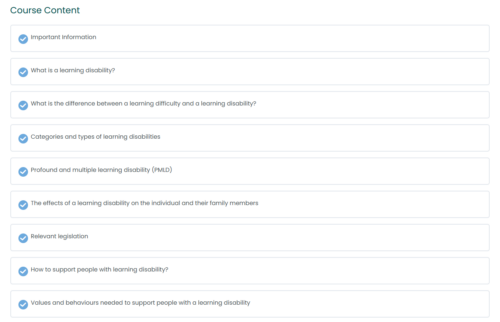
- Explain what a learning disability is
- Identify the difference between a learning difficulty and a learning disability
- List at least 3 categories and 10 types of learning disabilities
- Explain what is profound and multiple learning disability (PMLD)
- Explain the effects of learning disability on the person and their family
- List at least 3 pieces of legislation relevant to learning disability
- Describe how to support people with learning disability
- List 10 values and behaviours needed to support people with a learning disability
- Describe the role of partners in care and support
-
 Aim: To understand what anxiety is and how to assist people who have anxiety Objectives: By successfully completing this course, you will be able to:
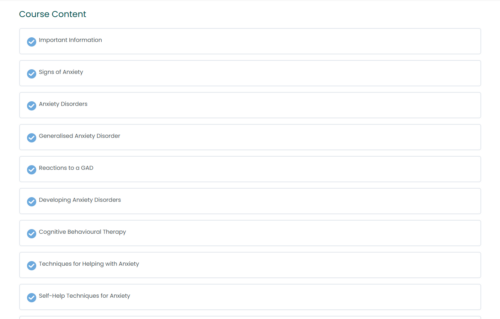
- Recognise at least 10 signs of anxiety
- Describe what an anxiety disorder is
- State at least 5 symptoms of a Generalised Anxiety Disorder
- Recognise that a Generalised Anxiety Disorder can affect different people in different ways
- Recognise at least 4 situations that could lead someone to develop an anxiety disorder
- Describe what Cognitive Behavioural Therapy is
- List at least 3 techniques for helping a person with anxiety to cope with the symptoms of an anxiety disorder
- List at least 3 self-help techniques for coping with the symptoms of an anxiety disorder
-
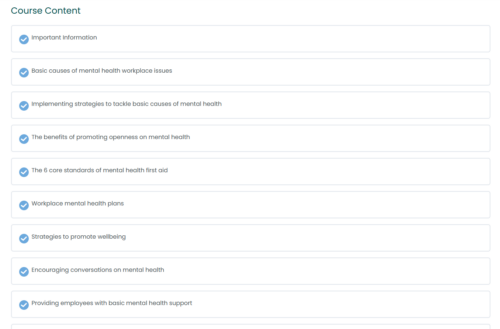
 Aim: To ensure that all members of staff are supported in the workplace. Objectives: By successfully completing this course you will be able to:
- Identify a minimum of 5 basic workplace causes of mental health issues
- Explain how to implement at least 5 strategies to tackle basic causes of basic mental health issues
- Describe the benefits of promoting openness about mental health
- Identify the 6 core standards of mental health first aid
- Explain how to create a workplace mental health plan
- List at least 6 strategies that you can implement to promote the wellbeing of all members of staff
- Identify at least 3 benefits of encouraging conversations about mental health
- Explain why it is important to provide employees with basic mental health support
- Identify at least 10 factors of the work environment of your team members that promote mental health
- Explain how to implement proactive opportunities for your team members to discuss their health and wellbeing, and the impact their work environment has on it, with their team leader(s)
- List at least 6 techniques for training individuals to be able to treat their colleagues in a way that does not negatively impact their mental health
- List at least 3 benefits of regularly monitoring the mental health of your team members
- List at least 3 methods of monitoring the mental health of your team members
- Explain what an annual wellbeing report is, and to know how to create one
-
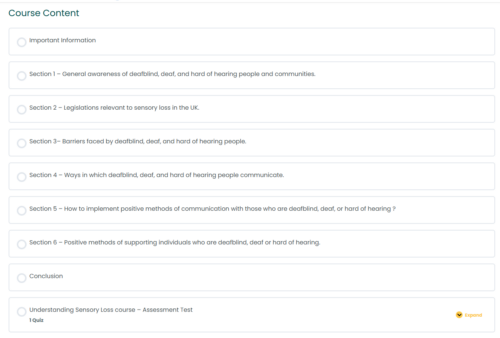
 Aim: To understand and provide support to deafblind, deaf and hard of hearing people and communities. Objectives: By successfully completing this course you will be able to:
- Demonstrate a general awareness of deafblind, deaf, and hard of hearing people and communities
- Describe the legislations relevant to sensory loss in the UK
- Identify the barriers that deafblind, deaf, and hard of hearing people face
- List the ways in which deafblind, deaf, and hard of hearing people communicate
- Understand how to implement positive methods of communication for those who are deafblind, deaf, or hard of hearing
- Describe positive methods of supporting individuals who are deafblind, deaf and hard of hearing
-

 Aim: To know how to embed inclusivity within your organisation and wider practices, with regards to disabilities and mental health. Objectives: By successfully completing this course you will be able to:
- Describe the Disability Confidence Framework
- List at least 3 benefits of the Disability Confidence Framework
- Explain about the different levels of the Disability Confidence Framework
- Describe how long a typical Disability Confidence Framework accreditation lasts for
- Describe how the Voluntary Reporting Framework works
- Describe the actions necessary to achieve or maintain the different levels of the Disability Confidence Framework
-

 Aim: To be able treat disabled individuals equally and equitably. Objectives: By successfully completing this course you will be able to:
- Explain what a disability is
- Describe what is contained in the Equality Act 2010, with regards to preventing discrimination against disabled individuals
- Explain the distinction between visible and invisible disabilities
- Describe the concepts of equality and equity
- Describe the social model of disability
- Identify 10 ways that an individual may require assistance due to a disability
- Identify 5 reasonable adjustments to your behaviour that you can make to assist disabled individuals around you
- Explain why it is important to follow the basics of etiquette, and not to make assumptions about disabled people
-

 Aim: To keep people safe by reducing the risk of, and knowing how to react to, fire in the workplace. Objectives: By successfully completing this course you will be able to:
- Describe the characteristics of fire, smoke, and toxic fumes
- Identify at least 6 fire hazards in the work environment
- Explain how to recognise any significant findings of fire risk evaluations
- Explain how to perform basic fire prevention, and the importance of local fire safety protocols
- Describe when it is necessary to raise the fire alarm, how to raise the fire alarm, and what to do if the fire alarm is raised
- Describe the actions to take if fire breaks out or if smoke is detected
- Identify the different types of fire extinguishers
- Explain about the different uses of fire extinguishers
- Identify the safety precautions associated with fire extinguishers
- Explain about the importance of being familiar with evacuation procedures and associated escape routes
-
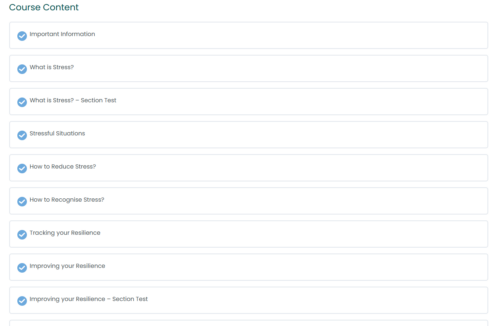
 Aim: To be able to manage your own levels of stress, and be able to gauge and increase your own resilience Objectives: By successfully completing this course you will be able to:
- Recognise four different categories of signs of stress
- Identify at least four different signs of stress
- Recognise what can contribute to a stressful situation
- Identify three things you can do to help deal with a stressful situation
- Identify three ways to reduce your stress levels
- Gauge what your level of resilience is
- List 3 things you can do to increase your level of resilience
-
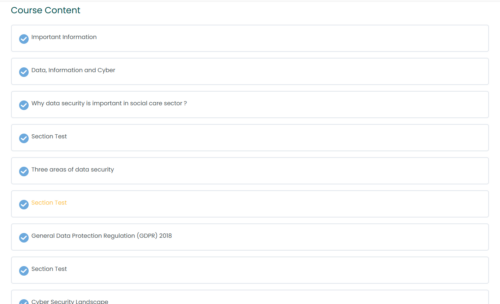
 Aim: To be able to handle technology and information in a lawful and secure way. Objectives: By successfully completing this course you will be able to:
- Identify the relation between Data, Information and Cyber
- Explain why data security is important in the social care sector
- Identify the 3 areas of data security
- Describe the General Data Protection Regulation (GDPR) 2018
- Explain about the cyber security landscape and the 4 major threats
- Identify counter measures to mitigate the 4 major cyber security threats
- List 5 responsibilities in handling technology and information securely
-
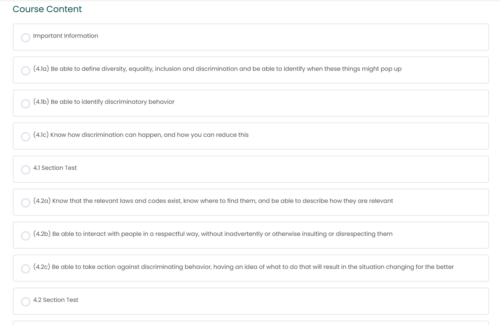
 Aim: To understand what is considered as discrimination, what can cause it, and how to respond in an effective way in order to reduce discrimination. Objectives: By successfully completing this course you will be able to:
- Explain diversity, equality and inclusion
- Explain what discrimination is
- Identify 3 pieces of legislation surrounding this topic
- Describe what you can and cannot do when you come across discrimination within your work place
- Explain how to ensure everyone is included fairly